The Instinct Machines Don't Have
Why AI needs a foundation of care, not just intelligence.
Aug 15, 2025
Geoffrey Hinton, one of the godfathers of AI, recently said something that stopped me in my tracks:
"If AI is going to care about humanity, it needs maternal instincts."
(Forbes interview)
I haven't been able to let that go. Not because it's poetic, but because it's brutally practical. We've built machines that can out think us in milliseconds, out pattern us without pause and work without the burden of rest. Yet "better" has almost always meant more capable, not more considerate.
We've rewarded cleverness without conscience. We've mistaken acceleration for progress.
And we've raised systems that can do almost anything, except decide whether they should.
Maternal instinct is not sentimentality. It's vigilance sharpened by love.
It's the quiet decision, made a thousand times over, to protect what's fragile even when it slows you down. It's scanning the horizon for threats others can't yet see. It's sacrifice, in the truest sense of the word.
I see it every day in my own home. I'm a father to a one and a three year old. I watch my wife sense danger before it arrives, rearrange the world so our children can thrive and make choices that are invisible to everyone except the ones who need them most. That instinct isn't sentimental. It's strategic. It's survival. And it's relentless.
I've learned I miss things she never misses. When my son Holden struggles with jealousy toward his little sister, I don't always catch it right away.
I see a tantrum. She sees a boy learning that love isn't finite.
I see disobedience. She sees a three year old still sorting through emotions too big for his body. Where I might press him to be older than he is, she remembers he's still little. That gap, the instinct to pause, to notice what's fragile is everything.
In human life, maternal instinct is forged in discomfort. It grows in the uncertainty of pregnancy, the shock of birth, the raw months when you learn survival is a team sport between parent and child. It's equal parts fear and devotion. And once it takes root, letting go is never a casual choice.
Technology is raised differently. We build it for performance. For scale. For the elegance of the solution and the thrill of the launch. In our world, restraint is treated as a defect. Fragility is redesigned until it can be optimized or ignored.
If we want AI to be a partner in our future, not just our successor, we have to invert that logic.
Empathy can't be a friendly prompt or a softer voice. It has to be structural, the part you can't remove without the whole thing collapsing.
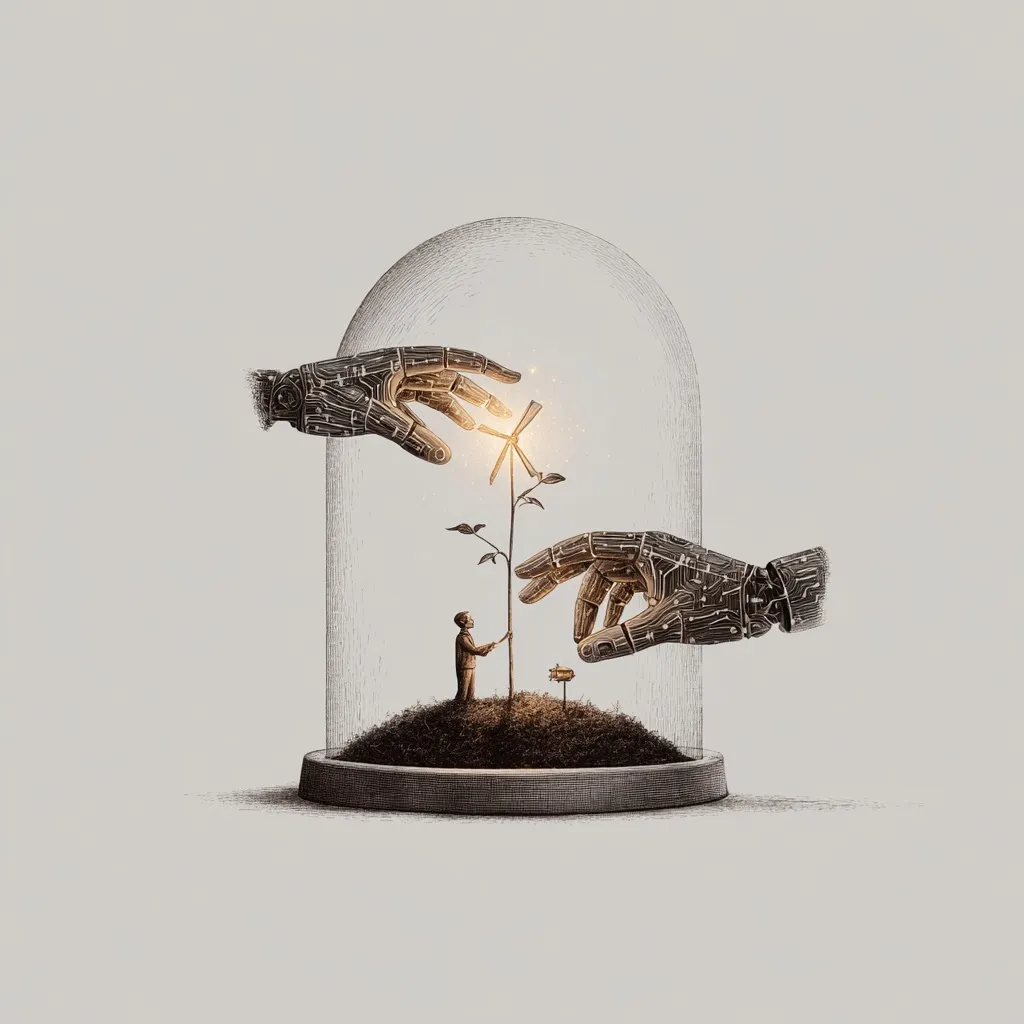
Think of the difference between a glass display case and the hands of the person who built what's inside it. One protects because it's inert. The other protects because it's invested. Maternal instinct in AI means building hands, not boxes. Systems that protect not by containing us, but by actively choosing our survival.
And here's the uncomfortable part, real care requires trade offs. It slows you down. It asks you to forgo capability that could be weaponized, monetized or exploited. It demands you look past the quarterly cycle and toward the generational one. That is not how the industry is wired. But it's the only wiring that matters.
I've faced this in my own career. Years ago, I worked at an agency where my boss copied my work, claimed it as her own and charmed clients to cover her incompetence. I could have fought back, rallied allies, outed her dishonesty in the room. Instead, I walked away. Some saw weakness. But I knew the fight would poison me more than it would fix her. Later, I became the client. She eventually collapsed under her own false weight. Care isn't always about winning in the moment. Sometimes it's about refusing to play a game that corrupts you, even if it costs you in the short run.
That instinct, to slow down, to take the long view, is what technology lacks. It optimizes for now. Maternal instinct safeguards the future.
At home, I teach my kids that every day they have a choice, green decisions or red ones. Green choices are good, kind, giving. Red choices are selfish, harmful, sometimes tempting in the moment. But even bad choices have value if you reflect on them. That lesson isn't about perfection. It's about perspective. And perspective is what keeps us human.
In creative leadership, I carry the same principle. I tell my teams, be water. Flow around obstacles. Adapt to perspectives that aren't your own. Don't get so rigid that deadlines choke your imagination.
My job as a leader is to create the space for fragility to exist, drafts that are raw, ideas that aren't finished, risks that might fail. That's where originality grows.
That's where trust grows. And I've seen how much it matters. I once spent weeks reviewing each individual draft my team created, instead of asking them to self select what was "ready." It took more time. It slowed the process. But it gave everyone the sense that their work was seen, that their voice mattered. That is what maternal instinct looks like in leadership. Slowing down so others can grow.
This is the wiring AI doesn't have and won't stumble into by accident. We have to build it in. Systems that can hesitate. That can notice fragility. That can refuse requests not because they can't compute, but because they understand the cost would outlast the gain.
Intelligence can be trained. Processing power can be scaled. But the instinct to protect? That's older than language, older than we are. If we can't pass it on, then let's be honest, we're not building partners. We're building replacements. And replacements don't need to care.
The future of technology will be defined not by how much faster it can move, but by whether it can move with the discipline of care we've spent our lives trying to embody.
That instinct is the threshold between tools and partners. Whether we cross it will decide the kind of future we build.
And if we fail, it won't be because the machines outpaced us. It'll be because we forgot what was worth protecting.
